MADISON, WISCONSIN--By the shores of Lake Mendota from 22 to 26 June, biologists at Evolution '99 revealed some surprising twists in nature's evolutionary course, from the ills of inbreeding to a complex three-way relationship among plants and moths.
For insects, as for people, the way to get the most out of life is often to form partnerships. In the case of several nondescript white moths, the partner is a desert plant, the yucca. At first glance, the relationship seems quite amiable: the moth pollinates yucca flowers and then lays its eggs there, where nascent seeds nourish the developing larvae.
But moths, like people, sometimes cheat on their partners when a third party enters the relationship, evolutionary biologist Olle Pellmyr from Vanderbilt University in Nashville, Tennessee, reported at the meeting. When two kinds of moths depend on the same yucca, "it's a different game," he says, opening the way for one moth to become a parasite of both the yucca and the other moth. "The bottom line is one [moth] can turn into a cheater if it can get another moth to carry the [pollination] burden," says Pellmyr.

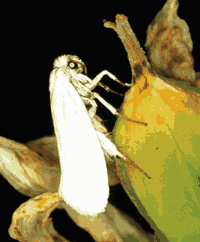
Slacker. Some moths that depend on the yucca plant have shifted
from pollinators (left) to parasites (right).
CREDITS: PELLMYR
The work "is an exquisite demonstration," showing "a deep understanding of evolutionary interactions," says Douglas Futuyma, an evolutionary biologist at the State University of New York, Stony Brook. "Even in mutualistic interactions, there are conflicts" over each partner's share of seeds, for example, "and this can lead to the evolution of parasitism."
Since 1992, Pellmyr and his colleagues have been documenting relations between 35 yucca species and the 13 moths that tend them. The system seems elegantly balanced: The moths have evolved large, specialized mouth parts to gather yucca pollen, and the plant guards against the moth larvae eating too many seeds by monitoring the egg load and dropping flowers with too many eggs before the seeds and fruit mature (Science, 25 August 1995, p. 1046). Some moths specialize on one yucca; others visit several species. But two of the moth species are different. They are "cheaters": They no longer have the pollen-gathering mouth parts, and they lay their eggs late, directly into the fruit or seed after the seed is set--thus avoiding the yucca's defense.
Pellmyr and his colleagues have now analyzed the cheaters' DNA, which shows that they evolved separately, and studied their ecology. The fieldwork shows that the cheaters flourish only where there is another moth also depositing its eggs on the same yucca species. Pellmyr concludes that a three-way relationship drove the moths to cheat. With two moths going after the same flowers, egg overload could be rampant. But if one moth species showed up late, it could bypass the plant's ability to drop off flowers containing too many moth eggs and could rely on the other, hard-working moth for pollinating duty.
For example, in Florida, where two moth species, Tegeticula yuccasella and T. cassandra, head for the same yucca, a new cheater species has split off from T. cassandra. Both moths inject their eggs just under the surface of yucca fruit, but T. cassandra deposits its eggs on day 1, and the cheater waits until 5 days later, Pellmyr reported. Furthermore, this cheater has not only stopped spending its energy growing special mouth parts and pollinating, but it has also lost its dependence on a single yucca species, and has spread westward, taking advantage of other moth-yucca partnerships all the way to New Mexico, Pellmyr says.
The other cheater also arose from a situation in which two moths depended on the same yucca. This second cheater visits a variety of yuccas in its southwestern U.S. habitat and is "a little more evolved," Pellmyr notes. It arrives very late, encountering 3-week-old fruit, and has a special knifelike appendage that it uses to place eggs deep into the hard fruit, directly onto the seeds.
Though the two cheaters originated in very different parts of the United States, Pellmyr's team has now found plants in New Mexico with both cheaters as well as a faithful pollinator. "We're itching to go study this more," he says. He also expects that this yucca has some additional means of keeping the parasite in check, because otherwise the cheaters could overwhelm the plant, and the yucca and its faithful pollinator would likely go extinct. No matter what turn the moth-yucca soap opera takes, says Futuyma, "the work is rapidly becoming a classic in evolutionary ecology."
The Perils of Genetic Purging
Charles Darwin was the first to document the evils of inbreeding, when he discovered that morning glories that fertilized their own flowers produced fewer seeds and stunted seedlings. But Darwin also found that inbreeding depression, as this decrease in fecundity is now called, could be reversible: After several generations of inbreeding, the morning glories recovered, producing a line so healthy and fertile that he named it Hero. Darwin couldn't explain the phenomenon, but a century later, in the 1980s, several researchers concluded that inbreeding purges deleterious genes from a population, and some suggested that it might help small populations of endangered species recover their vitality.
At the meeting, however, two evolutionary biologists warned that this "genetic purging" strategy works inefficiently if at all. Inbreeding small endangered populations any more than is necessary is "a bad idea," as evolutionary biologist Diane Byers of Illinois State University in Normal puts it. She reached that conclusion after analyzing 52 published plant experiments with evolutionary biologist Donald Waller of the University of Wisconsin, Madison.
Inbreeding depression occurs in part because individuals in a small, inbred population are more likely to inherit two copies of rare, deleterious versions of a gene. In bigger populations, the chance that one individual will inherit two copies of such genes is quite small, and those who carry only one copy don't express the negative traits. But the idea behind genetic purging is that, in small populations, the bad genes should gradually die out over time, because individuals carrying two copies of such genes are less likely to produce young.
Both plant and animal breeders often use purging to remove potentially lethal genes, breeding animals with close relatives until the trait disappears. And evolutionary geneticist Alan Templeton of Washington University in St. Louis found that further inbreeding decreased inbreeding depression in an endangered gazelle. So conservation biologists began to think that purging might help save other rare species.
To find out how well purging might work in nonagricultural plants, Byers and Waller gathered all the relevant studies, focusing on those that compared the amount of inbreeding depression in two sets of plants with different histories of inbreeding. If purging worked, then plants with a longer history of inbreeding--for example, those that had been self-fertilized for many generations--should show less inbreeding depression.
Overall, only 38% of the studies found definite evidence of genetic purging. And even when purging occurred, it removed only about 10% of the deleterious genes. "[Inbreeding depression] is not going to be eliminated, it's not even going to be cut in half," says Waller, though he admits that researchers don't know exactly why purging is so inefficient.
These results signal "a really important paper," says Lukas Keller, an evolutionary biologist at Princeton University in New Jersey. The analysis shows that the threat from deleterious genes "is not going to be reduced to zero" by purging. That means that further inbreeding of an endangered population carries a high risk of inbreeding depression, says Keller. "With conservation of endangered species, you can't afford that," he adds. "If you lose [individuals], that's a catastrophe."
Tracking a Sparrow's Fall
In the winter of 1989, harsh weather killed off all but 11 of some 200 song sparrows living on Mandarte Island, off the coast of Vancouver, Canada. For Princeton University's Lukas Keller, this catastrophe was one of a series that offered a rare opportunity to study the genetic costs of inbreeding. Inbreeding depression, in which recessive, deleterious genes are expressed in small populations, is well known in domestic animals and plants. But documenting it in the wild has proved surprisingly difficult, because researchers rarely know the family history of all the individuals in a wild population.
However, on Mandarte Island, researchers led by ecologists James N. M. Smith and Peter Arcese of the University of British Columbia have tracked every sparrow birth, death, immigration, and mating since 1959. Those detailed records allowed Keller to count the offspring of each bird that survived two population crashes, in 1979-80 and 1989, and match those numbers with the degree of relatedness between each bird's parents.
"In [inbred] females, there was a significant decrease in reproductive success," Keller reported at the meeting. The daughters of two siblings or of a parent mating with an offspring produced 48% fewer young than daughters of unrelated parents, while sons whose parents were closely related suffered only a slight drop in fecundity. The eggs of inbred daughters were less likely to hatch than eggs fertilized by inbred males.
Such documentation of reduced fitness is important, researchers say, because most evidence of inbreeding in wild populations is indirect, relying on signs such as abnormal sperm, as in cheetahs. "[Keller] has demonstrated that inbreeding has effects in natural populations," says Donald Waller, an evolutionary biologist at the University of Wisconsin, Madison. "That is usually very hard to measure."
Keller also studied how the sparrows' genetic diversity recovered after the population crashes. Working with molecular biologists Michael Bruford and Kathryn Jeffery of the Institute of Zoology in London, he analyzed microsatellites, small pieces of repetitive DNA that are highly varied in most populations. Microsatellite diversity dropped immediately after the population crash of 1989, "but it only took 3 years for the [diversity] to go back to normal levels," Keller reported.
In this case, Keller knew why the diversity rebounded so quickly:
new blood. On average, one new sparrow arrives each year from the mainland
to make Mandarte Island its home. Most evolutionary theory on the recovery
of genetic diversity after a bottleneck considers only the restorative
effects of mutations, which accumulate very slowly. But this result, Keller
says, "should make people reexamine the importance of immigration."
Volume 285, Number 5425 Issue of 9 Jul 1999, pp. 192 - 193
©1999 by The American Association for the Advancement of Science.