|
|
|
Roller
Coaster History
Part I
By: Jay
Ducharme |
| |

"The
first known records date back to the 1400s." |
|
 For many, amusement parks are primarily a summertime diversion. It's interesting
that the biggest attraction at most parks, the roller coaster, began in
the frigid winter climate of Russia. The first known records date back
to the 1400s. Large ice slides were constructed of wood. People would climb
a long set of stairs to the top for a swift but enjoyable ride to the bottom.
The experience was very much like the large, undulating slides that can
still be found at some parks today. The ice slides were so popular, they
soon caught on in other countries that had warmer climates. By the 1700s,
slides began appearing that didn't need ice. One-person sleds were constructed
with wheels underneath, and passengers could speed to the bottom of the
ride all year long. Many of these rides constructed in France were given
the name Les Montagnes Russe, which means Russian Mountains. Through the
next two centuries, their popularity increased. Larger and larger rides
were constructed.
For many, amusement parks are primarily a summertime diversion. It's interesting
that the biggest attraction at most parks, the roller coaster, began in
the frigid winter climate of Russia. The first known records date back
to the 1400s. Large ice slides were constructed of wood. People would climb
a long set of stairs to the top for a swift but enjoyable ride to the bottom.
The experience was very much like the large, undulating slides that can
still be found at some parks today. The ice slides were so popular, they
soon caught on in other countries that had warmer climates. By the 1700s,
slides began appearing that didn't need ice. One-person sleds were constructed
with wheels underneath, and passengers could speed to the bottom of the
ride all year long. Many of these rides constructed in France were given
the name Les Montagnes Russe, which means Russian Mountains. Through the
next two centuries, their popularity increased. Larger and larger rides
were constructed. |
| |
|
"There
were even attempts to build loop coasters as early as the 1840s." |
|
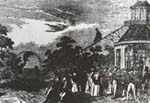 By the 1800s, continuous-circuit slides appeared in Europe. By using either
humans, animals or in some instances cables, the sleds were pulled from
the bottom back up to the top. Tracks were placed on the slides to keep
the sleds on course. Technology couldn't keep up with the public's demand
for thrills, and as the rides grew more dangerous, accidents became more
common. There were even attempts to build loop
coasters as early as the 1840s. The public didn't show an enormous interest
in these novelties and the slides themselves began to decrease in number.
By the 1800s, continuous-circuit slides appeared in Europe. By using either
humans, animals or in some instances cables, the sleds were pulled from
the bottom back up to the top. Tracks were placed on the slides to keep
the sleds on course. Technology couldn't keep up with the public's demand
for thrills, and as the rides grew more dangerous, accidents became more
common. There were even attempts to build loop
coasters as early as the 1840s. The public didn't show an enormous interest
in these novelties and the slides themselves began to decrease in number. |
| |
|
"...the
ends of the track were eventually joined together into a complete circuit
and a hoist system was added to pull the train to the top of the first
hill." |
|
 In the United States, little interest was shown in Russian Mountains. In
the early 1800s a gravity-powered transportation system for moving coal
was developed in Mauch Chunk, Pennsylvania.
The 18-mile-long circuit was made obsolete by the construction of a nearby
tunnel. The owners of the Mauch Chunk Railway put a passenger car on the
line and in 1874 began hauling paying customers instead of coal for a round-trip
of nearly an hour and a half. The cost was one dollar and the venture was
a success, demonstrating that people would pay money to coast down a hill.
Ten years later, LaMarcus Thompson, an inventor and businessman from Ohio,
installed his Switchback Railway at Coney Island, New
York. It was partly a Russian Mountain and partly the Mauch Chunk Railway.
Two tracks stood side by side. A single train-like car left the high point
at the station
at one end of one track and traveled down an undulating course powered
by gravity, only to rise back up to meet with the other end. The train
would enter the station on the opposite side and be switched back on to
the other track. The operator would then send the train off on a return
trip to the first station. The ride was an unparalleled success. Charging
only 5 cents a ride, Thompson made back his entire investment in about
a week. Thompson received patents on many features of his rides. Soon,
others began imitating and improving upon Thompson's work. Just as in the
earlier Russian Mountains, the ends of the track were eventually joined
together into a complete circuit and a hoist system was added to pull the
train to the top of the first hill. One design even used a track made of
hundreds of wheels and passengers sat in flat toboggans. This may be the
origin of the term roller coaster.
In the United States, little interest was shown in Russian Mountains. In
the early 1800s a gravity-powered transportation system for moving coal
was developed in Mauch Chunk, Pennsylvania.
The 18-mile-long circuit was made obsolete by the construction of a nearby
tunnel. The owners of the Mauch Chunk Railway put a passenger car on the
line and in 1874 began hauling paying customers instead of coal for a round-trip
of nearly an hour and a half. The cost was one dollar and the venture was
a success, demonstrating that people would pay money to coast down a hill.
Ten years later, LaMarcus Thompson, an inventor and businessman from Ohio,
installed his Switchback Railway at Coney Island, New
York. It was partly a Russian Mountain and partly the Mauch Chunk Railway.
Two tracks stood side by side. A single train-like car left the high point
at the station
at one end of one track and traveled down an undulating course powered
by gravity, only to rise back up to meet with the other end. The train
would enter the station on the opposite side and be switched back on to
the other track. The operator would then send the train off on a return
trip to the first station. The ride was an unparalleled success. Charging
only 5 cents a ride, Thompson made back his entire investment in about
a week. Thompson received patents on many features of his rides. Soon,
others began imitating and improving upon Thompson's work. Just as in the
earlier Russian Mountains, the ends of the track were eventually joined
together into a complete circuit and a hoist system was added to pull the
train to the top of the first hill. One design even used a track made of
hundreds of wheels and passengers sat in flat toboggans. This may be the
origin of the term roller coaster. |
| |
|
| |
|
As
more and more coasters began to appear in the United States, Thompson created
a ride known as the Scenic Railway. It was a complete-circuit roller coaster
that included many custom-designed scenes and special effects, similar
to rides like Disney's Pirates of the Carribean. The Scenic Railways were
another success for Thompson and he exported them to Europe, which began
to re-discover the thrill of roller coasters. |
| |
|
" It
wasn't until a man named John Miller entered the picture that roller coaster
technology advanced significantly." |
|
 Up until this time, even the fastest roller coaster went perhaps a dozen
miles an hour. The track was essentially a boxy wooden trough. The cars
that the passengers rode in consisted of four steel wheels underneath and
two on each side. The side
friction wheels would bump against the sides of the trough to keep
the car on course around corners. Because of this design limitation, the
rides had to be kept tame for safety's sake. It wasn't until a man named
John Miller
entered the picture that roller coaster technology advanced significantly.
As a young man, Miller was employed by LaMarcus Thompson to build Switchbacks
and Scenic Railways. He learned his craft well and by the early 1900s had
patented over 100 improvements in roller coaster technology. Among these
improvements were upstops (located underneath each car, preventing it from
coming off the track) and safety dogs (which make that familiar clanking
as a coaster is pulled up the lift hill, preventing the car from rolling
backwards). He popularized the practice of track banking, that is, tilting
the track on its side around turns. He was possibly the most prolific roller
coaster designer and builder in history with well over one hundred to his
credit. Some of his rides are still standing today. Among them are the
Racer and Jack
Rabbit at Kennywood Park
in Pennsylvania, The Big
Dipper at Geauga Lake in Ohio
and the Jack Rabbit
at Clementon Lake Park in
New Jersey. Miller was also the
first to create a Flying
Turns, where a bobsled-style
train
ran in a semi-circular trough. An example of a modern version of this is
Disaster Transport
at Cedar Point in Ohio.
Up until this time, even the fastest roller coaster went perhaps a dozen
miles an hour. The track was essentially a boxy wooden trough. The cars
that the passengers rode in consisted of four steel wheels underneath and
two on each side. The side
friction wheels would bump against the sides of the trough to keep
the car on course around corners. Because of this design limitation, the
rides had to be kept tame for safety's sake. It wasn't until a man named
John Miller
entered the picture that roller coaster technology advanced significantly.
As a young man, Miller was employed by LaMarcus Thompson to build Switchbacks
and Scenic Railways. He learned his craft well and by the early 1900s had
patented over 100 improvements in roller coaster technology. Among these
improvements were upstops (located underneath each car, preventing it from
coming off the track) and safety dogs (which make that familiar clanking
as a coaster is pulled up the lift hill, preventing the car from rolling
backwards). He popularized the practice of track banking, that is, tilting
the track on its side around turns. He was possibly the most prolific roller
coaster designer and builder in history with well over one hundred to his
credit. Some of his rides are still standing today. Among them are the
Racer and Jack
Rabbit at Kennywood Park
in Pennsylvania, The Big
Dipper at Geauga Lake in Ohio
and the Jack Rabbit
at Clementon Lake Park in
New Jersey. Miller was also the
first to create a Flying
Turns, where a bobsled-style
train
ran in a semi-circular trough. An example of a modern version of this is
Disaster Transport
at Cedar Point in Ohio. |
| |
|
"It is
estimated that during the Golden Age there were well over 1,500 roller
coasters in operation across the globe." |
|
Another
prolific design company of this period was the Philadelphia
Toboggan Company. They employed over the years many different designers,
including Miller, Joseph McKee, John
Allen and an apprentice of Miller's, Herb
Schmeck. There are probably more coasters designed by them that are
still standing than any other built before the Great Depression. That era
is known as the Golden Age of roller coasters. Hundreds of small parks
were in operation all through the United States, and each one featured
a roller coaster. It is estimated that during the Golden Age there were
well over 1,500 roller coasters in operation across the globe. Designers
and builders such as Prior
and Church, Harry
Baker, Vernon
Keenan and Harry Traver made names and fortunes for themselves building
high-thrill amusement rides for an eager public. |
| |
|
"Traver
believed that the public was ready for an extreme thrill ride, one that
caused onlookers to gasp in astonishment." |
|
 Harry Traver deserves special note. He was primarily a marketer of flat
rides, a generic term for non-coaster rides, he did design a few coasters.
His most famous was the Cyclone at Crystal Beach, Ontario, Canada in 1927.
Traver believed that the public was ready for an extreme thrill ride, one
that caused onlookers to gasp in astonishment. The Cyclone was that and
more -- it was also the most physically punishing ride ever built. It was
so common for passengers to leave the ride with broken ribs or snapped
collar bones, that a nurse station was located at the exit platform. The
public's response was to flock to Crystal Beach to view the terrifying
coaster -- but not to ride it. In those days, each ride was a separate
fee. Eventually the Cyclone couldn't pay for itself. Because of the extreme
design of the track, maintenance costs were very high. Eventually the ride
was torn down. That was the case with every coaster Traver designed. He
did begin a new trend, however: constructing the coaster's structure out
of steel.
Until that time, roller coaster's were built using the same technology
as old railroad bridges. Traver thought that steel would make a much more
cost-effective and durable material for the structure. (The track, however,
remained wood.) Though his track ripped itself apart, the structure proved
to be quite durable and still exists -- Herb Schmeck used the structural
steel from the Cyclone to build the Great Escape Comet. John Miller also
tried steel on his Coney Island Thunderbolt.
Harry Traver deserves special note. He was primarily a marketer of flat
rides, a generic term for non-coaster rides, he did design a few coasters.
His most famous was the Cyclone at Crystal Beach, Ontario, Canada in 1927.
Traver believed that the public was ready for an extreme thrill ride, one
that caused onlookers to gasp in astonishment. The Cyclone was that and
more -- it was also the most physically punishing ride ever built. It was
so common for passengers to leave the ride with broken ribs or snapped
collar bones, that a nurse station was located at the exit platform. The
public's response was to flock to Crystal Beach to view the terrifying
coaster -- but not to ride it. In those days, each ride was a separate
fee. Eventually the Cyclone couldn't pay for itself. Because of the extreme
design of the track, maintenance costs were very high. Eventually the ride
was torn down. That was the case with every coaster Traver designed. He
did begin a new trend, however: constructing the coaster's structure out
of steel.
Until that time, roller coaster's were built using the same technology
as old railroad bridges. Traver thought that steel would make a much more
cost-effective and durable material for the structure. (The track, however,
remained wood.) Though his track ripped itself apart, the structure proved
to be quite durable and still exists -- Herb Schmeck used the structural
steel from the Cyclone to build the Great Escape Comet. John Miller also
tried steel on his Coney Island Thunderbolt. |
| |
|
"As literally
thousands of parks fell into disrepair and closed their gates forever,
one new kind of park was taking shape." |
|
 Before much more experimentation with Traver's ideas could begin, the Great
Depression hit in 1929. Many amusement
companies quickly went bankrupt. Faced with a public that no longer had
spending money, many smaller parks couldn't survive. They closed, and the
magnificent roller coasters that had thrilled a generation were torn down.
After the Depression came the Second World War. It's thought that some
of Harry Traver's rides were sold to the Japanese as scrap metal and then
fired back at us as artillery. By 1950,
the only surviving coaster builders were the Philadelphia Tobbogan Company
and National
Amusement Devices. NAD built few coasters, and even fewer survive.
One is Serpent of Fire in Mexico City. Perhaps their most memorable contribution
was their coaster train design, beautiful stainless steel works of art
with headlights in front. One of the few remaining examples still runs
at Lakeside Park in Colorado.
As literally thousands of parks fell into disrepair and closed their gates
forever, one new kind of park was taking shape.
Before much more experimentation with Traver's ideas could begin, the Great
Depression hit in 1929. Many amusement
companies quickly went bankrupt. Faced with a public that no longer had
spending money, many smaller parks couldn't survive. They closed, and the
magnificent roller coasters that had thrilled a generation were torn down.
After the Depression came the Second World War. It's thought that some
of Harry Traver's rides were sold to the Japanese as scrap metal and then
fired back at us as artillery. By 1950,
the only surviving coaster builders were the Philadelphia Tobbogan Company
and National
Amusement Devices. NAD built few coasters, and even fewer survive.
One is Serpent of Fire in Mexico City. Perhaps their most memorable contribution
was their coaster train design, beautiful stainless steel works of art
with headlights in front. One of the few remaining examples still runs
at Lakeside Park in Colorado.
As literally thousands of parks fell into disrepair and closed their gates
forever, one new kind of park was taking shape. |

 Tuesday,
September 21, 1999
Tuesday,
September 21, 1999 


